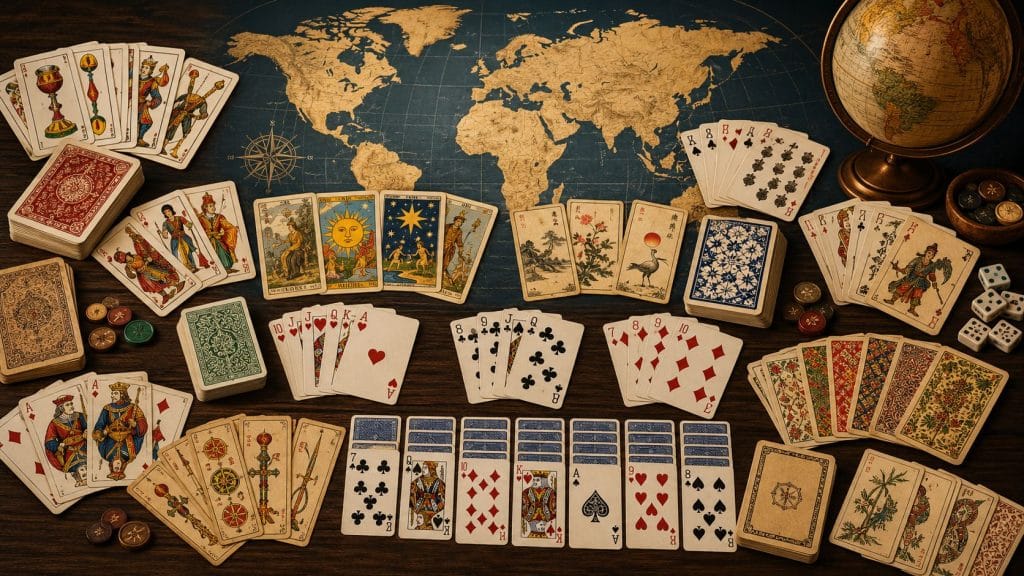
Shuffle a standard 52-card deck and you almost certainly create an arrangement no human has ever produced before. The number of possible orderings is 52 factorial, roughly 8.06 followed by 67 zeros, a figure so vast that every shuffle in history has likely been unique. From that single deck humanity has built thousands of games, and a handful of them have crossed every border, language, and generation.
Every Card Game in the World, Ranked: A Complete Popularity Guide
Shuffle a standard 52-card deck and you almost certainly create an arrangement no human has ever produced before. The number of possible orderings is 52 factorial, roughly 8.06 followed by 67 zeros, a figure so vast that every shuffle in history has likely been unique. From that single deck humanity has built thousands of games, and a handful of them have crossed every border, language, and generation.
(Disclaimer: While our title aims high, listing all ten thousand card games in human history would take a lifetime to read. Instead, we’ve focused on the ones that actually matter.)
This guide ranks the 30 most popular card games people actually play, from the global heavyweights to the regional classics that dominate one country and are barely known in the next. It covers how each game works, who plays it, where it is strongest, and the odd piece of history that makes it worth a second look. Whether you came here for the most popular card games on the planet, the best card games for two players, or something new for family night, there is a place for it below.
How This Ranking Works
Popularity is slippery, so the order here blends four signals rather than leaning on any single one. The first is global reach, meaning how many countries play a game with real regularity. The second is digital footprint: search demand, app installs, and online play, where a game like Solitaire shows its true scale. The third is regional dominance, because a game can be a near-religion in one nation and rank highly on sheer intensity. The fourth is competitive depth, the presence of clubs, leagues, and tournaments that keep a game alive for decades. A game that scores on all four sits near the top. A game strong on only one still earns its place, just lower down.
The Complete Ranking
Rank
Game
Category
Best player count
Where it is strongest
1
Poker (Texas Hold’em)
Betting / vying
2 to 10
Worldwide, USA
2
Solitaire (Klondike)
Patience / solo
1
Worldwide, digital
3
Blackjack
Casino / banking
1 to 7
Worldwide casinos
4
Rummy
Draw and discard
2 to 6
India, worldwide
5
UNO
Shedding
2 to 10
Worldwide
6
Bridge
Trick-taking
4
Worldwide clubs
7
Baccarat
Casino / banking
1 to 14
Asia, Macau
8
Hearts
Trick-taking
3 to 6
USA, Europe
9
Spades
Trick-taking
4
USA
10
Crazy Eights
Shedding
2 to 7
Worldwide
11
Go Fish
Matching
2 to 6
Worldwide, kids
12
War
Comparing
2
Worldwide, kids
13
Euchre
Trick-taking
4
USA Midwest, Canada
14
Cribbage
Matching / counting
2
UK, USA
15
Pinochle
Trick-taking / melding
4
USA
16
Canasta
Rummy family
4
Americas, Europe
17
Skat
Trick-taking
3
Germany
18
Belote
Trick-taking
4
France
19
Briscola
Trick-taking
2 to 4
Italy
20
Scopa
Fishing
2 to 4
Italy
21
Durak
Shedding / beating
2 to 6
Russia, Eastern Europe
22
Teen Patti
Betting / vying
3 to 6
India
23
Whist
Trick-taking
4
UK, historical
24
Old Maid
Matching
2 to 12
Worldwide, kids
25
Snap
Matching / speed
2 to 8
Worldwide, kids
26
Spoons
Matching / speed
3 to 13
USA
27
President (Big Two)
Shedding
3 to 7
Worldwide
28
Gin Rummy
Draw and discard
2
USA
29
Tarot (Tarocchi)
Trick-taking
3 to 5
France, Italy
30
Casino War
Casino / comparing
1 to 6
Worldwide casinos
The Global Giants
These are the games that travel. They turn up in casinos, on phones, at kitchen tables, and in tournament halls, and between them they account for most of the card playing that happens on any given day.
Poker earns the top spot because it is two things at once: a casual home game and a professional sport with millions in prize money. Texas Hold’em is the version that conquered the world, helped by a single famous moment in 2003 when an amateur named Chris Moneymaker turned an 86-dollar online qualifier into a 2.5-million-dollar World Series of Poker title. Television and online rooms did the rest. The rules are simple to grasp and a lifetime too short to master, which is exactly why it endures.
Solitaire is the quiet giant. Most people who play it have never bought a deck, because the game arrived on hundreds of millions of computers preinstalled. Microsoft shipped its version with Windows in 1990, built by a summer intern named Wes Cherry, with the elegant card faces drawn by designer Susan Kare. It was not there to entertain. It was there to teach a generation how to use a mouse, since dragging a card onto a pile was the perfect lesson in click, hold, and drop. It worked, and then it never left.
Blackjack is the most played banking game in any casino, and the reason is math. With correct basic strategy the house edge drops to around half a percent, better odds than almost anything else on the floor. Its mythology helps too, from card counters to the MIT team that beat Vegas for years. The game moved online without losing a step, and today it stretches from live-dealer studios to crypto Blackjack games, where the same basic strategy applies but bets settle in Bitcoin or stablecoins rather than chips at a table. The core stays unchanged: get closer to 21 than the dealer without going over.
Rummy is a giant largely because of one country. In India it is woven into festivals and family gatherings, and because courts there have treated it as a game of skill, a large legal online rummy industry has grown around it. The draw-and-discard format, where you build runs and sets and race to empty your hand, has spawned dozens of variants across the world, from Gin Rummy in the United States to Rummikub on tiles.
UNO proves that a game does not need a 52-card deck to take over the world. It was invented in 1971 by Merle Robbins, a barber from Ohio, who spent 8,000 dollars printing the first 5,000 decks and sold them from his shop. He later sold the rights for 50,000 dollars plus a dime per game, a bargain that became one of the best-selling card games ever made. Its mix of color matching, number matching, and gleeful sabotage cards keeps it on shelves more than fifty years later.
Bridge sits sixth on raw numbers but first on depth. No other card game has the same competitive infrastructure: national federations, world championships, master points, and a literature of strategy that runs to thousands of books. It is a partnership trick-taking game built around bidding, and it rewards study like a sport. Its most famous evangelists, Warren Buffett and Bill Gates among them, treat it as a lifelong discipline rather than a pastime.
Trick-Taking Classics
Trick-taking is the oldest and richest family of card games, where players each contribute a card to a round and one of them wins the pile based on suit and rank. Bridge is the crown, but it has many relatives.
Hearts is the friendly assassin of the group, an evasion game where you try to avoid winning points, except for the daring play of “shooting the moon” by taking them all. Spades is its partnership cousin, hugely popular in the United States and a fixture of online play. Euchre is fast, sharp, and beloved across the American Midwest and Canada, played with a stripped deck and a fierce loyalty among its fans. Pinochle adds melding to the trick-taking, using a special 48-card deck. And Whist, now mostly historical, is the direct ancestor of Bridge and ruled English card tables for two centuries.
Regional Powerhouses
Some games barely register globally yet completely dominate their home turf. Ignoring them would miss where a huge share of the world’s card playing actually happens.
Baccarat is the quiet king of the casino world. In Macau, the most lucrative gambling hub on earth, baccarat has for years driven the overwhelming majority of table revenue, and at its peak Macau pulled in many times what the entire Las Vegas Strip earned. The game itself asks almost nothing of the player, just a bet on the banker, the player, or a tie, which is part of its appeal to high rollers who want pure chance at high stakes.
Skat is Germany’s national card game, a three-player trick-taking contest of genuine strategic weight that has its own court rules and a dedicated following. Belote plays the same role in France, a near-universal evening pastime. In Italy, Briscola and Scopa are the games families reach for, the latter a “fishing” game where you capture cards from the table. Durak, meaning “fool,” is the default card game across Russia and much of Eastern Europe, the loser being whoever is left holding cards. And Teen Patti, often called Indian Poker, fills homes across South Asia during Diwali.
Family and Casual Favorites
Not every game wants a strategy book. These are the ones that teach children how to play cards and keep the whole table laughing.
Crazy Eights, the ancestor of UNO, where you match rank or suit and eights are wild.
Go Fish, the gentle matching game that is most people’s first.
War, pure luck and pure simplicity, flipping cards to see whose is higher.
Old Maid, a matching game built entirely around the dread of one lonely card.
Snap and Slapjack, speed games that reward fast hands and quick eyes.
Spoons, the chaotic scramble where the real game is grabbing cutlery before your friends.
Casino Card Games Worth Knowing
Beyond the giants, the casino floor hosts a cluster of card games built around a house bank. Blackjack leads, for the low house edge already mentioned, and crypto Blackjack games have carried it onto blockchain platforms with the same rules intact. Baccarat follows on sheer volume. Three Card Poker compresses poker into a quick, dealer-versus-player format. Pai Gow Poker blends a Chinese tile game with a poker deck and is famous for its slow, low-volatility pace. And Casino War, the grown-up version of the children’s classic, is the simplest bet in the building.
Best Card Games by Player Count
The “right” game depends entirely on how many people are at the table. Here is the short version.
Best card games for two players: Cribbage, Gin Rummy, Briscola, War, and the two-handed form of Euchre. Cribbage in particular was practically designed for a duel.
Best card games for three players: Skat, Hearts, Rummy, and Crazy Eights all work cleanly with an odd number.
Best card games for four or more: Bridge, Spades, Euchre, Canasta, and Pinochle shine with a full table and partnerships.
Best solo card games: Klondike Solitaire and its harder cousins FreeCell and Spider, all playable alone with a single deck or a phone.
Best family card games: UNO, Go Fish, Crazy Eights, Old Maid, and Snap, easy to learn and forgiving of young players.
Honorable Mentions
A few games sit just outside the deck but belong in any honest conversation about card play. Mahjong and Dominoes use tiles rather than cards, yet they fill the same social space across Asia and the Caribbean. Magic: The Gathering and the Pokémon Trading Card Game built an entire industry on collectible cards, with competitive scenes and secondary markets worth a fortune. They are not playing-card games in the traditional sense, but they command millions of devoted players.
Five Things You Probably Did Not Know About Card Games
The four kings in a standard deck were once said to represent four real rulers: Charlemagne, David, Caesar, and Alexander, though the link is more legend than fact.
Tarot cards were invented for playing trick-taking games in 15th-century Italy. Their use in fortune telling came centuries later.
The Joker is an American invention, added in the 1860s as a trump card for the game of Euchre.
Microsoft Solitaire was reportedly so popular in offices that it became a running joke about lost productivity, yet it taught a generation the mouse skills modern computing depends on.
A “standard” deck is not universal. Italy, Spain, Germany, and Switzerland all use regional decks with different suits, such as cups, coins, swords, and clubs.
Frequently Asked Questions
What is the most popular card game in the world? By the broadest measure that combines casinos, home play, and online activity, Poker and Solitaire are the two strongest contenders. Poker leads on cultural reach and prize money, while Solitaire likely wins on raw number of games played thanks to its presence on every computer.
What is the easiest card game to learn? War and Go Fish are the simplest, which is why they are the games most people learn as children. Crazy Eights is the easiest step up once those feel too basic.
What is the best card game for two players? Cribbage is the classic answer, since it was built for two and stays interesting for years. Gin Rummy and Briscola are excellent alternatives.
What card games can you play alone? The Solitaire family is the answer. Klondike is the famous one, while FreeCell rewards planning and Spider scales in difficulty for players who want a longer challenge.
Which card game has the best odds in a casino? Blackjack, played with correct basic strategy, offers one of the lowest house edges of any casino game, which is a large part of why it remains so popular both on the floor and online.
The Bottom Line
Card games survive because a single cheap deck holds almost endless variety, from a five-minute round of War to a lifetime of studying Bridge. The rankings shift by country and by decade, but the appeal does not. Whatever you are after, a quick family game, a sharp two-player duel, a solo round to pass the time, or a seat at a high-stakes table, the deck in your drawer can deliver it. The only hard part is deciding what to deal next.
The difference between Random Number Generator (RNG) card games and live dealer games comes down to how the result is created. Both formats provide fairness...
The integration of SpinPlus into the GameZone ecosystem brings a centralized hub for casino-style entertainment. Players can transition seamlessly between classic slots and regional card...
Finding a secure online gambling platform requires a methodical approach to checking critical safety metrics. Verifying regulatory compliance through trusted international authorities, validating software providers,...
Ontario's provincial lottery operator now requires online players under 25 to establish mandatory deposit limits upon hitting specific activity levels. This shift introduces proactive guardrails...
Nevada’s iGaming and gaming sectors show early signs of recovery with revenue gains in early 2026. Discover how digital innovation and upcoming sports infrastructure are...
An inside look at Verde Casino's controversial "Enigma Gifts" program. By blending behavioral psychology with surprise rewards like mystery cashback and free spins, the platform...
Ontario is shifting player protection from a voluntary option to a mandatory condition for younger users. Under a new rule from the Ontario Lottery and...