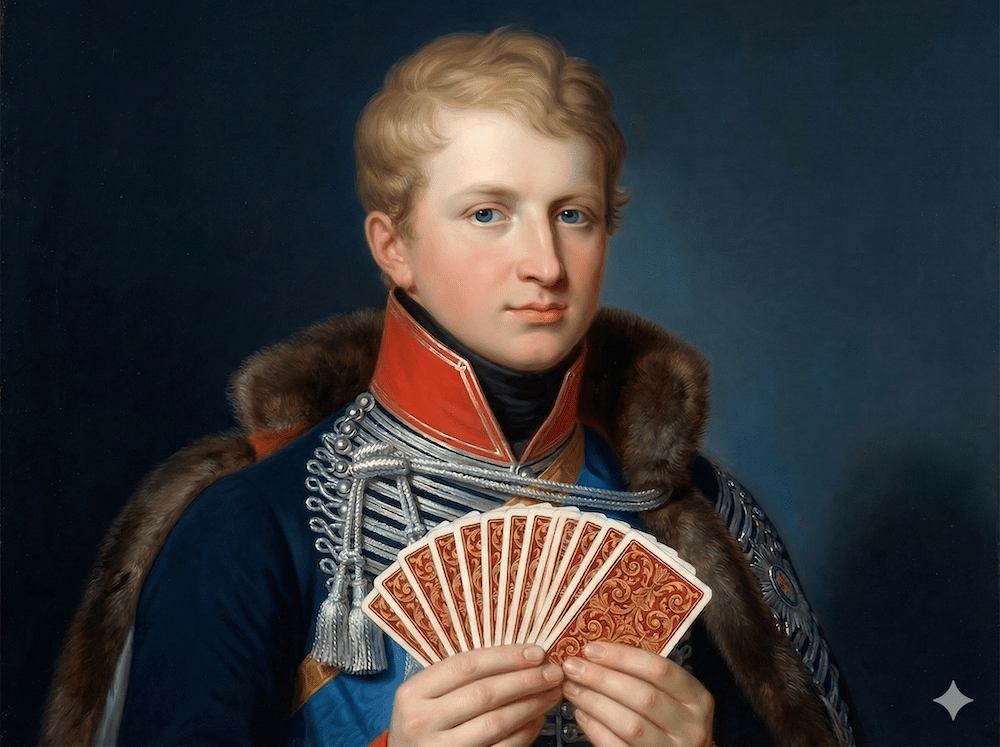
The legend of the Cumberland Hand stands as the ultimate cautionary tale from the wood-paneled rooms of the Portland Club. Dealt a hand of near-mathematical perfection, the Duke of Cumberland was baited into a staggering £20,000 wager, only to watch in horror as his opponents executed a flawless, pre-planned defense. This single moment of high-stakes deception proved that without rigid, codified laws, even a royal could be fleeced by a “sure thing.”
The £20,000 Trap: The Legend of the Cumberland Hand
The Scene: A Night of Royal Hubris
Imagine the scene: it’s the early 19th century inside the candlelit, wood-paneled rooms of London’s most exclusive card room, the Portland Club. The air is thick with the scent of expensive tobacco and the quiet rustle of silk.
The Duke of Cumberland, a man accustomed to winning, sits across from a seemingly unassuming opponent. He looks down at his hand and nearly stops breathing. He holds the Aces, Kings, and Queens of three suits, plus a formidable string of trumps. In the world of card games, this isn’t just a good hand—it’s a statistical miracle.
As the story goes, his opponents bet that he would not make a single trick in his hand. He accepted the bet and lost all thirteen tricks. Confident that he was holding an invincible collection of cards, the Duke reportedly wagered a staggering £20,000—roughly £2.5 million in today’s money.
He is about to be systematically dismantled without winning a single trick.
The Anatomy of a Disaster
The Hand
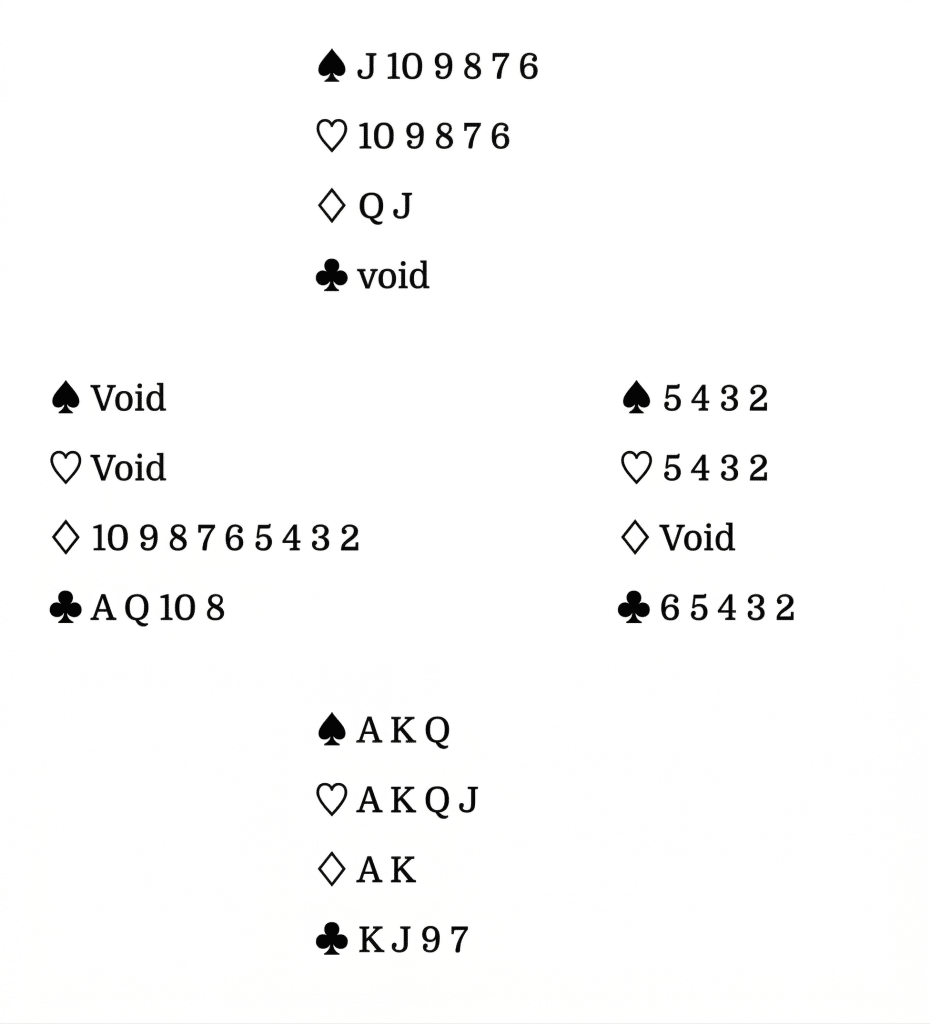
How does a man holding nearly every high card in the deck lose everything? The Duke’s hand (holding 33 out of 40 High Card Points) was a powerhouse:
♤ A K Q ♡ A K Q J ♢ A K ♧ K J 9 7
The game was Whist, not bridge, and the trump suit in Whist was decided by the last card dealt. The Duke was the dealer (which is why he had the first lead), and the “turn-up” card was a Club.
The Trap
His opponents had “stacked” the rest of the deck so that every time the Duke led one of his massive Aces or Kings, one of his opponents had a low trump card ready to “kill” it.
Following whist principles of the time, the Duke led the ♣7. North won with the ♣8, and after two diamond ruffs and two further club leads through the Duke, North could draw the last trump and cash the seven remaining diamonds.
The Layout: The Cumberland Trap
Dealer: South | Trumps: Clubs ♣
In the circles of the Portland Club, the “Cumberland Hand” isn’t just a story about a bad run of cards—it is the ultimate cautionary tale about a rigged deck.
The Duke was the victim of a “cold deck” (a pre-stacked deck swapped into the game). His opponents didn’t just hope he would lose; they engineered a hand that looked mathematically invincible to goad him into a massive, life-altering wager.
The identity of the specific scoundrel who rigged the deck remains one of history’s best-kept secrets, but the “why” is as clear as a fresh deck of cards: it was a classic, high-stakes fleecing.
The Duke of Cumberland (the son of King George III) was a notorious high-roller with a reputation for being somewhat arrogant at the table. This made him the perfect mark for a “cold deck” swap.
The Setup: Why and How
The Motive: Pure profit. The wager of £20,000 in the early 19th century is equivalent to nearly £2 million (or $2.5 million) today. His opponents didn’t just want to win a game; they wanted to engineer a life-changing windfall.
The Rig: The hand was mathematically constructed by professional card sharps (some sources suggest it was first conceptualized by the famous card authority Edmond Hoyle as a theoretical curiosity, which the cheaters then put into practice).
The Trap: They dealt the Duke the most “perfect” hand imaginable—top honors in every suit. This ensured he would not only feel confident but would be “incensed” enough by their challenge to accept an astronomical bet.
The Execution: Because it was a game of Whist (where no hands are exposed), the Duke had no idea his opponents knew exactly what he held. By using a “distribution trap,” they forced him to lead trumps, only to find the opponents held the length and the ability to ruff his winners.
The Lesson of the Portland Club
This hand became legendary at the Portland Club not just because of the money lost, but because it proved a fundamental truth about card games: Strength is relative. The club’s role as the “guardian of the rules” was born from moments like this. They realized that for a game to be fair, the laws must be precise enough to protect the integrity of a wager. They did this by standardizing the shuffle, the deal, and the penalties for irregularities—to make the game a test of skill rather than a test of who could better exploit a distribution, to ensure that if a player lost a fortune, it was due to the luck of the cards or a failure of strategy, not a failure of the game’s framework.
The “007” Twist: Reclaiming the Hand
Over a century later, Ian Fleming—himself a frequent player at the Portland Club—resurrected this “ghost” for his novel Moonraker.
In the book, the villainous Sir Hugo Drax is a cheat who uses his wealth and position to bully other players. James Bond, realizing Drax is “stacking” the deck, manages to switch the cards so that Drax ends up holding the Duke of Cumberland’s “unlosable” hand.
Bond sits back and watches as the villain, bloated with overconfidence, bets his entire fortune on a hand that Bond knows—mathematically and legally—cannot win a single point. It was the ultimate “poetic justice” delivered via the Portland Club’s rulebook.
The legend of the Cumberland Hand stands as the ultimate cautionary tale from the wood-paneled rooms of the Portland Club. Dealt a hand of near-mathematical...
Huff N’ Lots of Puff redefines the slot experience by moving away from passive spinning toward a goal-oriented progression system. Players collect Hard Hats and...
Traditional card games like bridge and whist established a strategic foundation that continues to resonate throughout the modern gaming industry. Beyond the mere mechanics of...
These small-but-mighty titles offer everything from sprawling narrative RPGs to fast-paced platformers, all without demanding a massive hard drive or a high-end graphics card.
Master the Philippines' favorite card game with our easy-to-follow guide. From understanding Tongits rules and mechanics to learning the step-by-step tutorial used by the pros,...
Online gaming platforms work best when they pair popular games with clear rewards. The GameZone system uses a rebate feature to give something back to...