Master the Philippines’ favorite card game with our easy-to-follow guide. From understanding Tongits rules and mechanics to learning the step-by-step tutorial used by the pros, we break down how to form melds, call a “Draw,” and avoid being “Burned.” We’ll have you shouting “Tongits!” in no time.
How to Play Tongits: Complete Rules and Tutorial
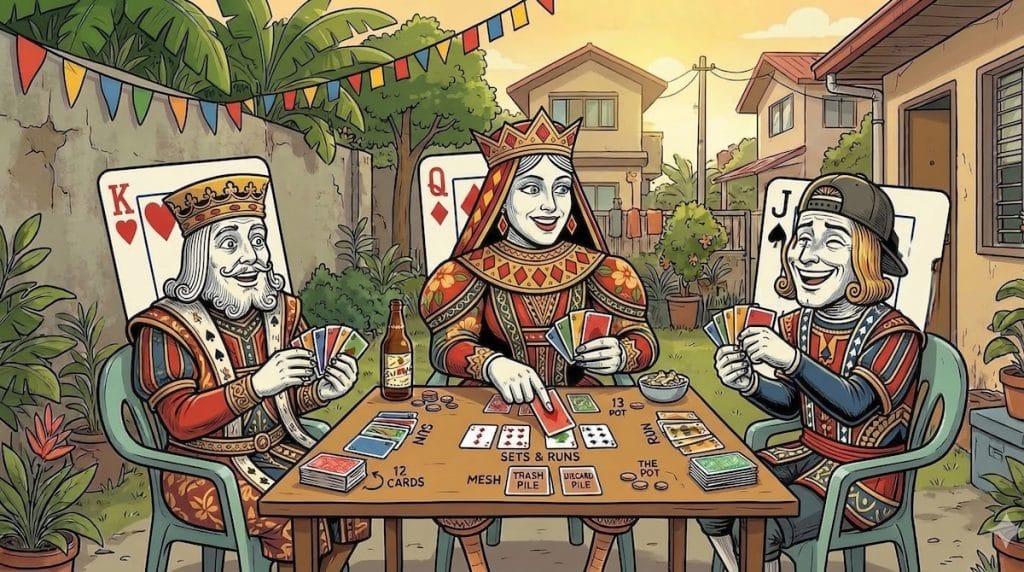
If you’ve ever walked through a neighborhood in the Philippines and heard the rhythmic “clack” of cards on a wooden table, you’ve heard Tongits. It’s a fast, addictive, three-player game that’s a mix of Poker and Rummy.
Think you’ve got what it takes to win the pot? Here is everything you need to know to get started.
Tongits Rules & Mechanics
Before you start dealing, let’s look at the “engine” of the game. It’s simpler than it looks!
The Players: You need exactly three people. Not two, not four.
The Goal: Get rid of all your cards or be the one holding the “weakest” (lowest scoring) cards when the deck runs out.
The “Sets” and “Runs”: To win, you need to group your cards into Melds.
Three of a Kind: Like three Kings or three 7s.
A Straight Flush: Three or more cards of the same suit in a row (like the 5, 6, and 7 of Hearts).
Card Points: If you’re stuck with cards at the end, they cost you points. Aces are 1 point, Face cards (J, Q, K) are 10 points, and everything else is its face value. Low points = Good.
How to Play Tongits Step by Step
Ready to play? Here is a typical round, broken down step by step:
Step 1: The Deal
The dealer gives 12 cards to the other two players and 13 cards to themselves. The rest of the deck stays in the middle.
Step 2: Starting the Game
The dealer goes first. They can either lay down a “Set” or “Run” on the table to show they’ve started, or they can just throw one unwanted card into the “Trash” pile.
Step 3: Your Turn (Draw and Dump)
When it’s your turn, you do three things:
Pick up: Grab the top card from the deck or take the last card someone threw away (but only if it completes a set in your hand).
Show your cards: If you have a set, you can lay it face-up on the table. This is called “Opening your hand.” You must do this at least once to have a chance at winning.
The Dump: You must end every turn by throwing one card you don’t want onto the trash pile.
Step 4: The “Sapaw” (Connecting)
See a set of three 8s that your opponent put on the table? If you have the fourth 8 in your hand, you can “connect” it to theirs! This is a great way to get rid of cards.
How to Count Points in Tongits
When the game ends—either because the deck is empty or someone called a Draw—you need to add up the points of the cards left in your hand. Any cards already placed in melds on the table count as zero points.
Use this simple guide to calculate your score:
Card Type
Point Value
Aces
1 Point
2 through 9
Face Value (e.g., a 5 is 5 points)
10, Jack, Queen, King
10 Points each
Example of a Hand Count:
Imagine the game ends and you are holding a King of Hearts, a 7 of Spades, and an Ace of Diamonds.
King: 10 points
7: 7 points
Ace: 1 point
Total Score: 18 points
The Golden Rule of Counting: In Tongits, lower is always better. If your total is 18 and your opponent has 25, you win! This is why experienced players try to “dump” their high-value cards (Kings, Queens, Jacks) early in the game if they can’t fit them into a set.
Why Counting Matters for the “Draw”
You should only call a Draw if your point total is very low (usually under 10–15 points). If you call a Draw while holding two Kings, you’re almost guaranteed to lose the challenge!
Tongits Tutorial: How to Win (or lose)
There are three ways to end the game. Knowing when to use each one is how you become a pro.
1. The “Tongits” (The Wipeout)
This is the best way to win. If you manage to use every single card in your hand by making sets or connecting to other people’s sets, you yell “Tongits!” and the game is over. You win the maximum amount of money or points.
2. Calling a “Draw” (The Bluff)
If you think your hand is better (lower in points) than everyone else’s, you can shout “Draw!” at the start of your turn.
The Risk: Your opponents can “Challenge” you. If they show their cards and their points are lower than yours, you lose.
The Rule: You can’t call a Draw if someone just connected a card to your sets on the previous turn.
3. Running out of Cards
If the deck in the middle is empty and no one has called Tongits, everyone counts their points. The person with the lowest total wins.
4. The Burn
Don’t get “Burned” (Sunog)! If the game ends and you never laid down a single set on the table, you are “Burned.” This means you lose automatically and usually have to pay a penalty. Even if you have a bad hand, try to “open” it early!
Common Tongits House Rules (Regional Variations)
In many Filipino households, the standard rules are just the starting point. Depending on who you’re playing with, you might encounter these “House Rules” that add a bit of spice (and extra risk) to the game.
1. The “Challenger Wins” Rule
In the official Pagat rules, a tie during a “Draw” challenge goes to the challenger. However, some house rules are even stricter: they say that if you call a Draw and anyone at the table has the same number of points as you, you lose. It makes calling a Draw a very gutsy move!
2. The “Secret” Four-of-a-Kind (Bahay)
In some games, if you are dealt four of the same card (like four Jacks) right at the start, you can lay them face down.
This counts as “opening” your hand.
It keeps your cards a secret from opponents.
It usually pays out a higher bonus at the end of the round.
3. The “Two-Roll” Jackpot
This is the most popular way to play for stakes. To win the “Pot” (the money collected from every round), a player must win two rounds in a row.
If Player A wins the first round, the pot stays.
If Player A wins the second round, they take the whole pot.
If Player B wins the second round, Player A’s streak is broken, and Player B now needs to win the next one to take the pot.
4. Unlimited Sapaw (Connect)
While the standard rule says you can’t call a Draw if someone “Sapaws” (connects) to your cards, some house rules allow you to “Sapaw” your own cards to get rid of them faster without locking yourself out of calling a Draw.
5. The “10-Card” Burn
To make the game faster, some groups play with a rule that if the deck runs out and you still have 10 or more cards in your hand, you are automatically “Burned,” regardless of whether you opened your hand or not. It forces players to be more aggressive with their melds.
From the Table to Your Phone: Transitioning to Tongits Go
Now that you’ve mastered the rules, you’re ready to take your skills digital. While the traditional game is a staple of Filipino gatherings, Tongits Go has revolutionized how the game is played today. It stays remarkably faithful to the rules we’ve covered, but it adds a fast-paced, competitive layer with players from all over the world. Whether you’re practicing your “Sapaw” against AI or challenging pros in high-stakes tournaments, an app is the perfect place to sharpen your strategy without needing a physical deck. Just remember: whether you’re playing on a wooden table or a smartphone screen, the thrill of shouting “Tongits!” feels exactly the same.
The digital evolution has redefined "play" by merging the mathematical discipline of tabletop strategy with the high-stakes environment of virtual casinos. Through live-dealer technology and...
Euchre provides a high-velocity alternative to Bridge by utilizing a condensed 24-card deck and a unique trump hierarchy centered on the Jacks, known as Bowers.
Navigating the New Zealand online gaming market requires more than just luck; it requires a roadmap. With new 2026 regulations narrowing the field to licensed...
Every spin on a digital slot is governed by a hidden mathematical blueprint. While Return to Player (RTP) dictates the theoretical payback over millions of...
A secure sweepstakes experience begins with a slow approach to registration and a fast look at the fine print. By prioritizing encrypted logins and hard...
Bridge Base Online has entered a new era with the launch of GIBBO, a neural-network-powered AI designed to think—and bid—like a human. Plus, we look...