What Is a Bridge Tally?
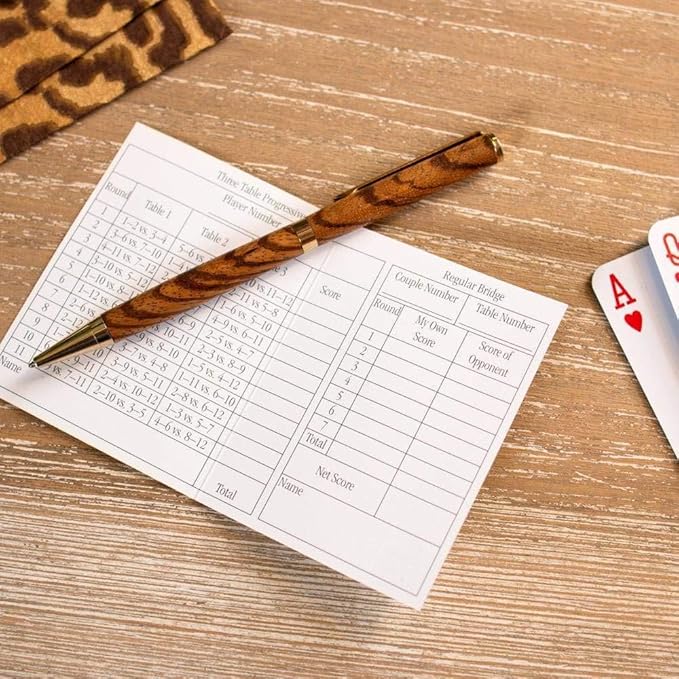
A bridge tally is a tool used to organize home bridge games with more than one table. It tells players where to sit, who they play with, and who they play against. Tallies are most common in social or party bridge games.
Bridge is not only about bidding and scoring. In home games, it is also about rotating players, changing partners, and keeping the game moving. A bridge tally handles this without one person having to direct traffic.
What a Bridge Tally Does
A bridge tally shows:
- Where a player or pair sits each round
- Who their partner is
- Who their opponents are
- Sometimes, where to record scores
Each player or pair gets their own tally card. Players follow the instructions round by round.
Pairs Bridge Tallies
Pairs tallies are used when players stay with the same partner for the whole session.
How pairs tallies work:
- Each pair is assigned a number (Pair 1, Pair 2, etc.)
- The tally shows which table the pair plays at each round
- Partners stay together throughout the game
- The tally shows opponents and playing direction (North-South or East-West)
- Some tallies include space to record scores
Pairs tallies are common when couples or regular partners want to play together.
Individual Bridge Tallies
Individual tallies are used when partnerships change every round. These are common in party bridge.
How individual tallies work:
- Each player is assigned a number
- The tally shows which table the player goes to each round
- The tally shows who the player partners with each round
- Players change partners throughout the session
- Many tallies include space to record individual scores
Individual tallies ensure everyone plays with and against many different people.
How Many Tables Can Tallies Handle?
Tallies are designed for specific numbers of tables and players.
Common sizes:
- 2–3 tables (8–12 players)
Used for small home games
- 4–5 tables (16–20 players)
Common for larger social gatherings
- 6–8 tables (24–32 players)
Used for clubs or large parties
Each tally set only works for the number of tables it was designed for.
Where Tallies Are Used
Bridge tallies are mainly used in casual settings:
- Home bridge parties
- Social bridge groups
- Progressive bridge games
They are rarely used in formal tournaments, where software or directors manage movement.
A Short History of Bridge Tallies
Bridge tallies appeared in the early 20th century. They were created to manage movement and scoring in progressive bridge games, where players moved tables after each round.
Tallies came as cards, booklets, or sheets. Many were decorative and matched the social nature of bridge parties, especially in the 1920s through the 1950s.
Progressive Bridge and Tallies
In progressive bridge, players move tables after each round. Tallies made this possible without confusion.
During the peak years of home bridge, tallies were standard equipment for hosting a game.
Tally Ho Bridge Tallies
One well-known brand was Tally Ho.
Tally Ho produced:
- Individual tallies for up to 8 tables (32 players)
- Couples tallies for up to 6 tables (24 players)
- Laminated, spill-resistant tally cards
- Refillable tally sheets and score pads
- Large, easy-to-read type
Tally Ho is no longer in business, but many players still remember and reuse their tallies.
Common Bridge Movements That Use Tallies
Mitchell Movement
- Used with an even number of tables
- North-South pairs stay seated
- East-West pairs move
- Common in club games
- Tallies mainly guide East-West movement
Howell Movement
- Used with fewer tables, often 5–7
- All pairs move (sometimes one pair stays put)
- Each pair has a tally showing table, opponents, and boards
- Common for small games
Ardisson Movement
- A variation of Howell
- Used with an odd number of tables
- Less common
- Improves balance in awkward table counts
Best Tally Choices for Home Games
- 4 players (1 table)
No tally needed. Rotate partners if desired.
- 8 players (2 tables)
Mitchell movement is common.
Simple tallies help East-West pairs move.
- 9–12 players (3 tables)
Howell movement works best.
Each pair needs a tally.
- Odd number of tables
Howell is usually used.
Ardisson is sometimes used but less common.
For Howell and Ardisson games, pre-printed tallies or software are helpful.
Where to Find Bridge Tallies Today
Even though Tally Ho is gone, bridge tallies are still available:
Custom and handmade tallies are also sold online.