What is the Gambler’s Fallacy?
Why Our Brains Expect the Universe to Balance the Books
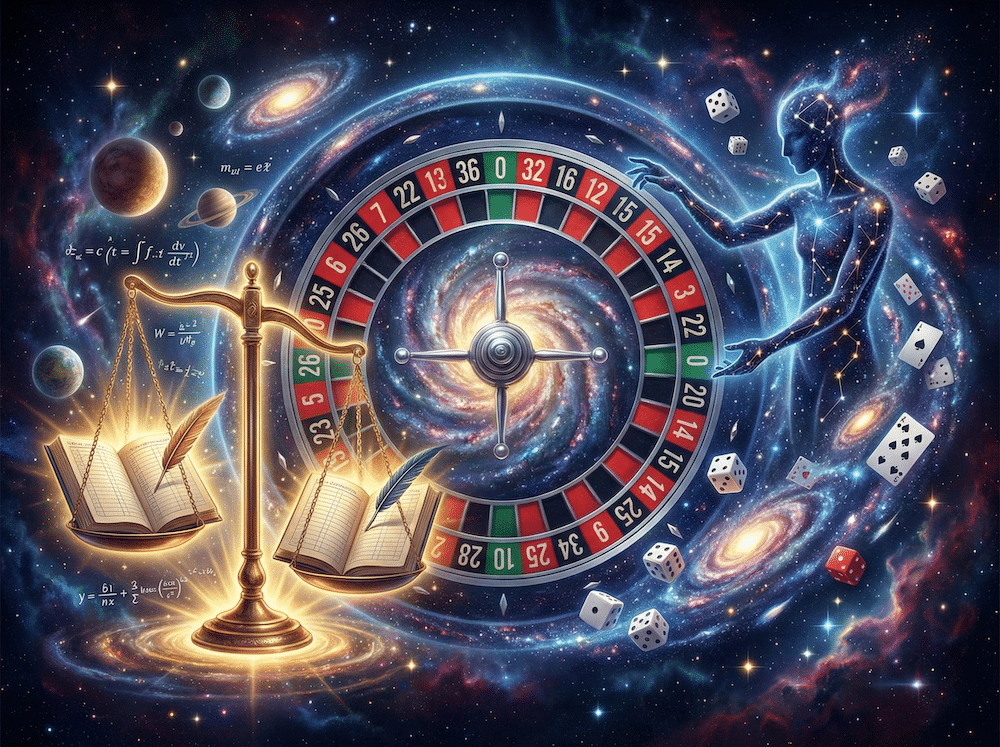
Imagine you are standing at a polished mahogany roulette table in the heart of Monte Carlo. The air is thick with the scent of expensive perfume and desperate hope. The ivory ball clatters against the spinning wood, settling into a black pocket. Then it happens again. And again. By the time the ball hits black fifteen times in a row, the crowd is frantic. Rational people begin emptying their pockets to bet on red, fueled by a powerful, seductive whisper in their minds: It has to happen soon. Red is overdue. The universe must balance the books.
This is the siren song of the Gambler’s Fallacy, one of the most persistent and costly glitches in human logic. To understand why we fall for it, we first have to understand the flawed architecture of the human brain. We are not naturally born statisticians; we are born pattern-seekers.
The Biological Root of the Error
Understanding Cognitive Bias
The Gambler’s Fallacy is a specific type of cognitive bias—a systematic error in thinking that occurs when our brains take mental shortcuts to process information. In the prehistoric past, these shortcuts kept us alive. If a hunter saw the grass rustle and assumed a predator was there, he survived, even if it was just the wind. Our ancestors were rewarded for seeing patterns where none existed.
Today, however, that same hardware causes us to stumble. We fall victim to a gallery of mental errors, such as Confirmation Bias, where we only notice information that fits our beliefs, or the Availability Heuristic, where we overestimate the danger of an event simply because it is easy to visualize. The Gambler’s Fallacy is the crown jewel of these errors, convincing us that the past can somehow dictate the future in a game of pure chance.
Defining the Fallacy
The Myth of the Due Win
At its core, the Gambler’s Fallacy is the mistaken belief that if an event happens more frequently than normal during a given period, it will happen less frequently in the future. It is the feeling that “luck” is a finite resource that eventually runs out, or a pendulum that must swing back to the center. But the cold reality of mathematics is indifferent to our feelings. In a game of independent events—like flipping a coin, rolling dice, or spinning a roulette wheel—the outcome of the next turn is entirely unaffected by what happened before it.
The Mathematics of Independence
Why the Coin Has No Memory
The math is uncompromising. If you flip a fair coin, the probability (P) of it landing on tails is always:
P (tails) = 0.5
It does not matter if you have flipped twenty heads in a row. The coin has no memory. It does not feel “guilty” for favoring heads, and it feels no pressure to correct the streak. Each flip is a brand-new universe with a $50\%$ chance for either side. People often confuse this with the “Law of Large Numbers,” which states that a sequence of events will eventually reflect the true probability over a massive sample size. While it is true that a million coin flips will eventually look like a $50/50$ split, that “balancing” happens through the sheer volume of new data, not because the universe forced a specific result to fix a short-term streak.
A Legend of Logic Failure
The 1913 Monte Carlo Disaster
The most legendary display of this mental trap occurred on August 18, 1913, at the Casino de Monte-Carlo. That night, a roulette ball hit black twenty-six times in a row. As the streak grew, players lost millions of francs betting against it. They weren’t betting on the wheel; they were betting against the “unfairness” of the streak. They were convinced that the longer the streak lasted, the more likely it was to end on the very next spin. They failed to realize that the odds of the 26th spin being black were exactly the same as the first.
Beyond the Casino Floor
Real-World Consequences
This fallacy doesn’t stay confined to the gambling hall; it leaks into our professional and personal lives. Investors often sell a skyrocketing stock because they feel it is “due” for a crash, or they pour money into a failing venture because a turnaround is “overdue.” Even doctors can be affected, subconsciously expecting a different diagnosis for a new patient simply because the last three patients shared the same illness.
Protecting Your Logic
How to Think Clearly
Protecting yourself from the Gambler’s Fallacy requires a deliberate shift in thinking. You must learn to identify “independent events” and treat them as such. Whenever you feel the urge to say a result is “due,” ask yourself a simple question: Does the machine, the ball, or the coin remember what it did last time? If the answer is no, then the past is a ghost. To navigate a world of randomness, we must accept that the universe is not a scale seeking balance—it is a series of moments, each one as fresh and unpredictable as the first.
My mother used to use a ‘betting system’ which would keep her on track and disciplined. Betting systems not only prevent us from going off the rails of our budget for the session, but they keep ones mind in the game. Of course, her game was blackjack and in blackjack like many card games, there are a limited number of cards – so if you’ve seen a lot of low cards, it’s not Gambler’s Fallacy to think a high card is ‘due.
Independent vs. Dependent Trials
The Gambler’s Fallacy only applies to “independent trials”—situations like roulette, dice, or a slot machine where the machine “resets” after every turn. A roulette wheel doesn’t lose a pocket once the ball lands in it; the physical conditions remain identical every time. Blackjack is fundamentally different because it is a “dependent” system. When a dealer draws an Ace from the shoe and places it in the discard pile, that Ace is physically gone. The composition of the remaining deck has changed. Because the “sample space” is shrinking, the probability of future events actually does shift based on the past. This is the scientific foundation of Card Counting. If a disproportionate number of low cards (2s through 6s) have been dealt, the deck becomes “rich” in high cards (10s through Aces), which mathematically favors the player. In this specific context, a high card isn’t just “due” because of a feeling; it is statistically more likely because there are fewer alternatives left in the deck.
The risk occurs when a player takes the “dependent” logic of Blackjack and tries to apply it to “independent” games. Because card games teach us that the past matters, our brains naturally want to apply that same logic to the lottery or the craps table.
This is why my mother’s discipline was her greatest asset. Whether the math was changing (like in Blackjack) or staying the same, her ability to keep her “mind in the game” and stick to a pre-set plan is what truly separates a disciplined player from someone falling victim to cognitive bias. She wasn’t just playing against the dealer; she was playing against the natural human tendency to lose control.
Here are examples of Independent and Dependent games you might find at a casino.
Independent Games
In these games, the “memory” resets. Each round is a brand-new random event, and the Gambler’s Fallacy is most likely to occur here.
- Roulette
- Craps / Dice Games
- Slot Machines
- The Lottery
- Keno
- Coin Flipping
Dependent Games
In these games, the “memory” remains. Previous actions physically change the odds of future outcomes, making strategy and “tracking” mathematically valid.
- Blackjack
- Poker
- Bingo
- Horse Racing / Sports Betting